Glee Parking · Hardware specs
Cheese: a thin, stick-on parking sensor
A 6.7 mm sheet, glued to the middle of a parking space, that tells whether a car is parked on top and reports it over a low-power radio network. No drilling, no camera.
We're sharing the design early so people who know hardware, streets or parking can tell us what we're missing.
Status: early design. Nothing on this page has been built or tested with real cars yet. The figures are design targets and estimates, not measurements. Parts for a first test kit were ordered on November 7, 2026.
How it works
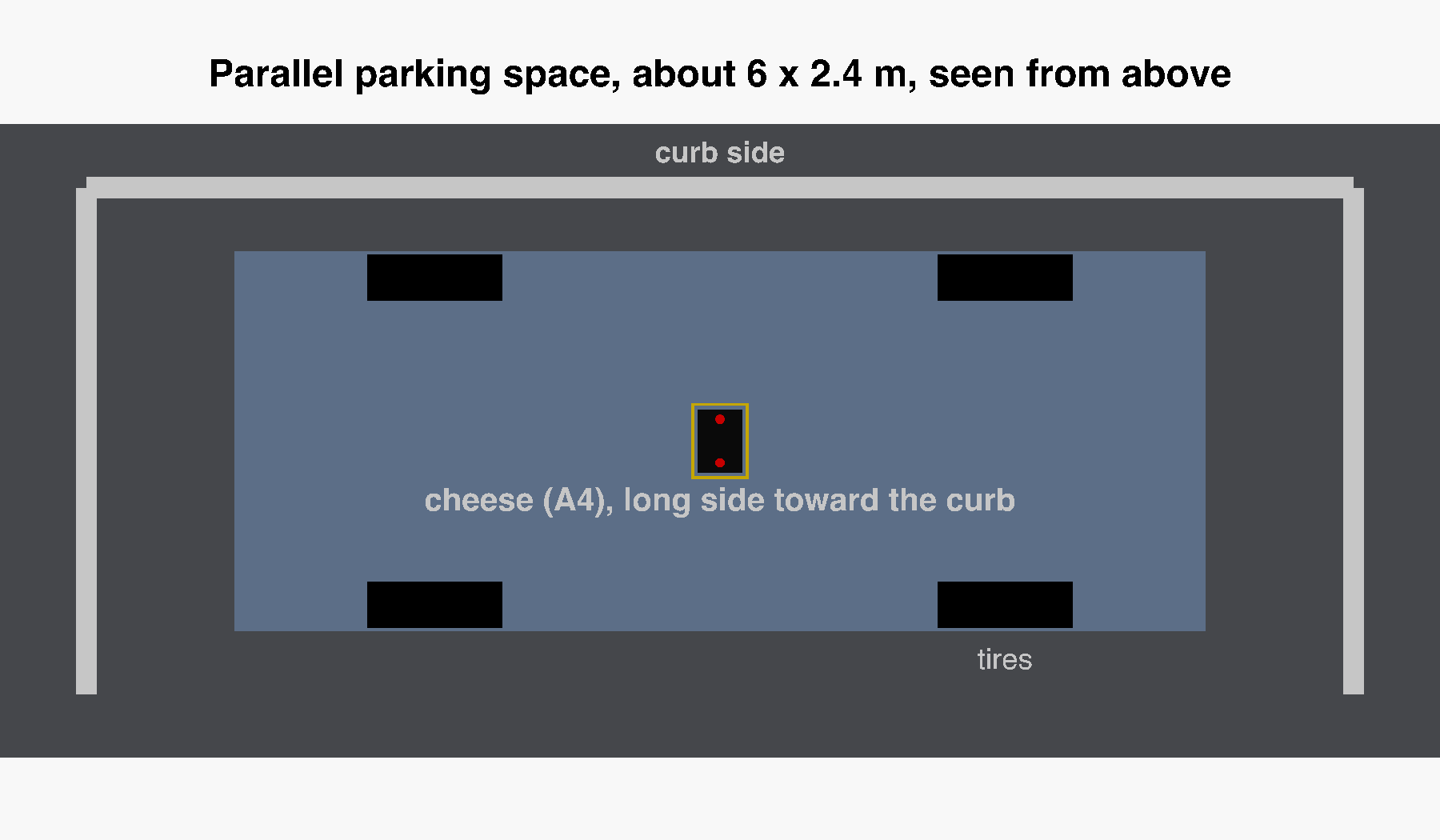
Cheese sits in the middle of the space, between the wheel tracks, with its long side pointing toward the curb. A parked car is a large mass of steel, and it changes the magnetic field around it.
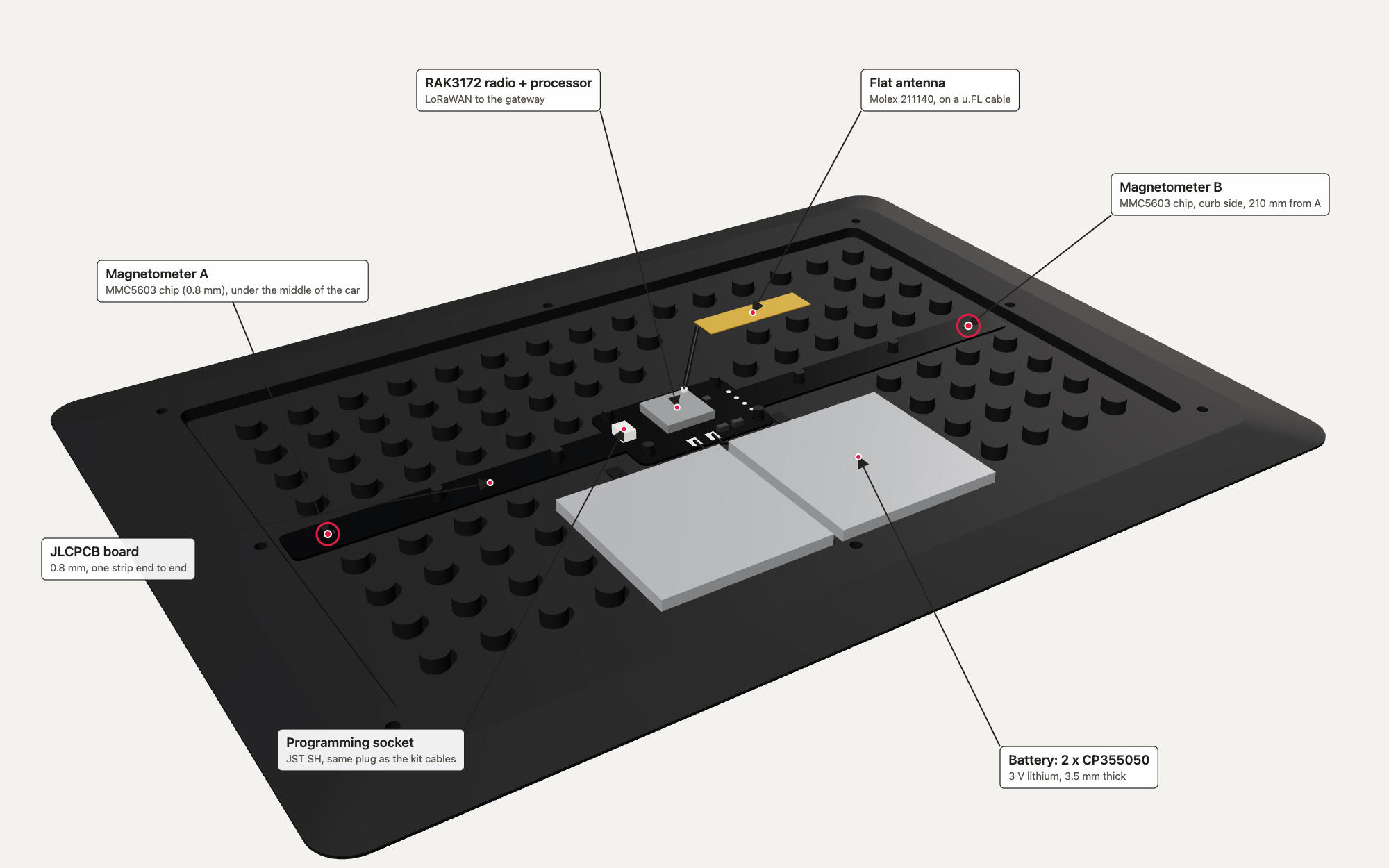
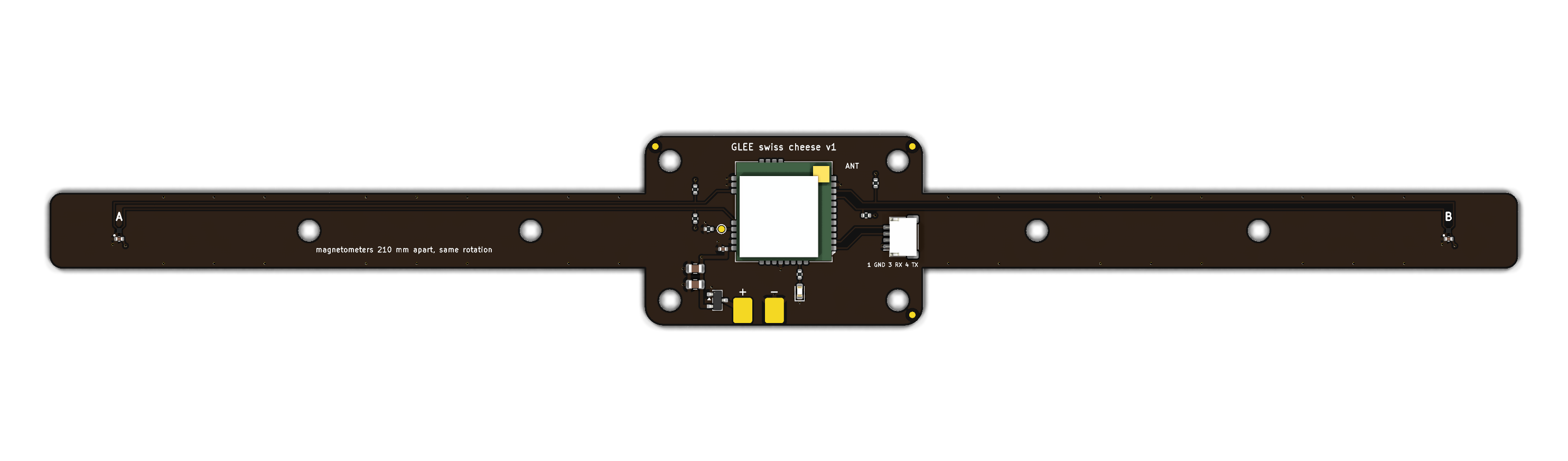
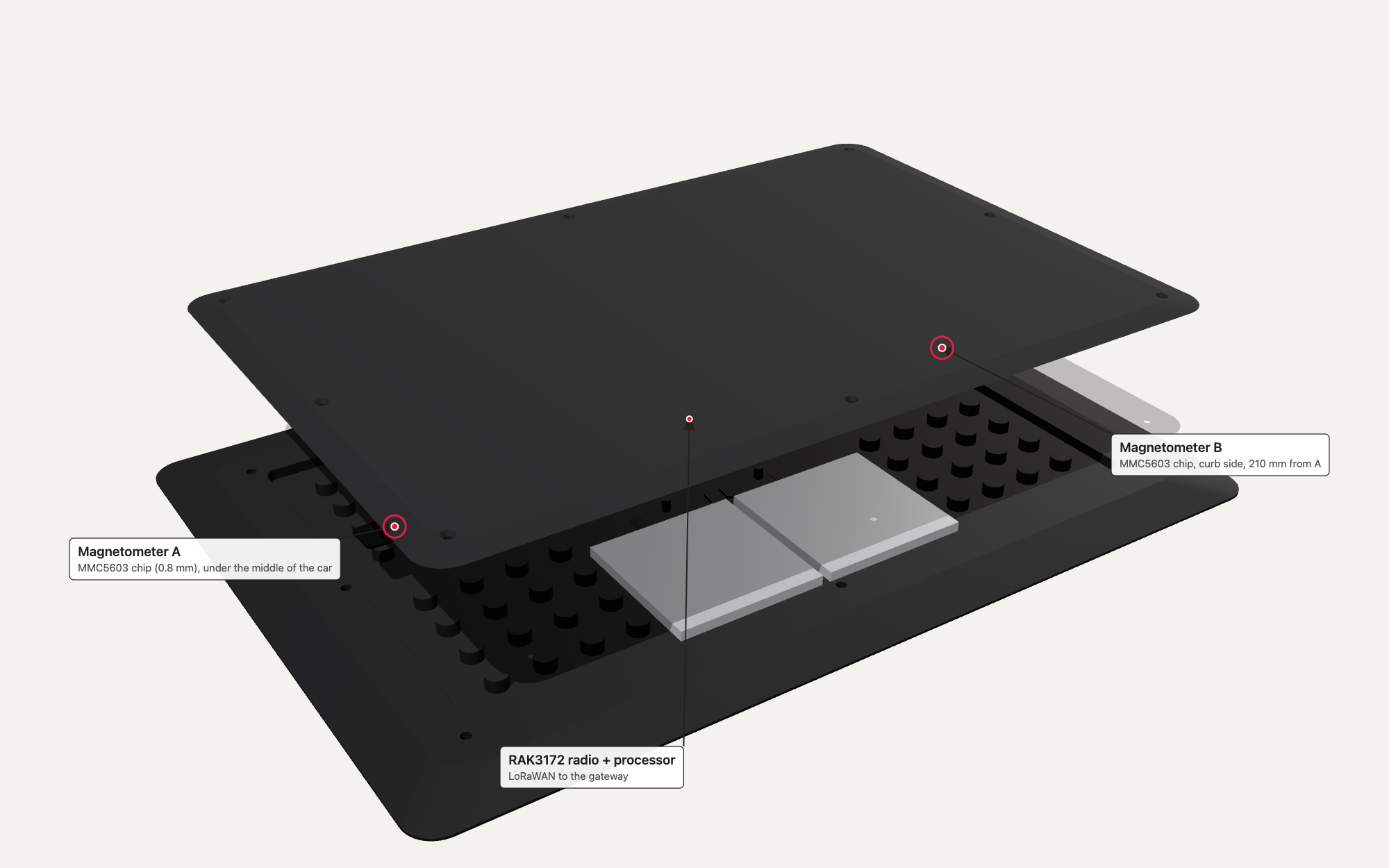
There's a magnetometer at each end of the sheet, 210 mm apart. A car parked on top changes the field differently at the two ends because it's so close. A car in the next space changes both ends about equally. So Cheese calls a space occupied only when the field changes and the two ends disagree.
- It reads the field every 3 seconds.
- It decides "free" or "occupied" itself. Each 11-byte message holds that answer, the size of the field change at each end, its battery level and its temperature.
- It transmits only when the state changes, plus a short check-in every hour.
- Target: an arrival shows on the map in about 10–15 seconds.
What's inside
Physical
| Size | 297 × 210 × 6.7 mm. About 8.5–9 mm on the road, including the adhesive |
| Edges | Sloped 1:4, so wheels, plows and street-sweeper brooms ride up and over |
| Shell | 3D-printed black polycarbonate blend. 1.5 mm lid on 7 mm posts every 15 mm, so a tire's load goes into the posts, not the parts. 1.0 mm floor, 4.2 mm cavity |
| Top surface | Black epoxy with aluminum-oxide grit for grip when wet |
| Screws | Brass or nylon, so no magnetic metal sits near the sensors |
Sensing
| Sensors | 2 × MEMSIC MMC5603NJ magnetometers, 210 mm apart |
| Detection rule | Field change of at least 5 µT at either end, and a difference between the ends of at least 2 µT. These starting values come from simulations and will be tuned with real cars |
| Not included | No camera, microphone, radar or license plate reader. It can't tell which car is parked |
Radio
| Module | RAKwireless RAK3172-T (LoRaWAN, US 902–928 MHz), rated to −40 °C |
| Antenna | Molex 211140 flat 915 MHz antenna, 0.1 mm thick |
| Transmit power | 20 dBm (100 mW) or less |
| Range | About 200–400 m to a gateway with a car parked on top, from a model. To be measured |
| Network | The Things Network, through our own gateway |
Power
| Battery | 2 × CP355050 lithium manganese dioxide cells: 3.0 V, 2,000 mAh each, 3.5 mm thick, rated −20 to +60 °C. Not rechargeable |
| Average draw | About 15–25 µA estimated. Target: under 60 µA |
| Life | About 5 years, estimated. We'll measure the real draw on the first prototype |
| Regulator | None: the cells power the electronics directly, so nothing wastes current while idle |
Electronics
| Circuit board | Custom 2-layer board: a 232 × 12 mm strip with a 44 × 30 mm hub, 0.8 mm thick. Made and assembled by JLCPCB |
| Extras | Reverse-battery protection, a programming socket, and an LED that blinks only at power-up and when it joins the network |
Installation
| Adhesive | Butyl road-marker pads with pavement primer, the kind used to glue reflectors to roads |
| Removal | Pry up with a flat shovel. Butyl pads are sold as coming off without damaging asphalt or concrete; we haven't tested this yet |
| Time | About 10 minutes per sensor, estimated |
Compared with what we use today
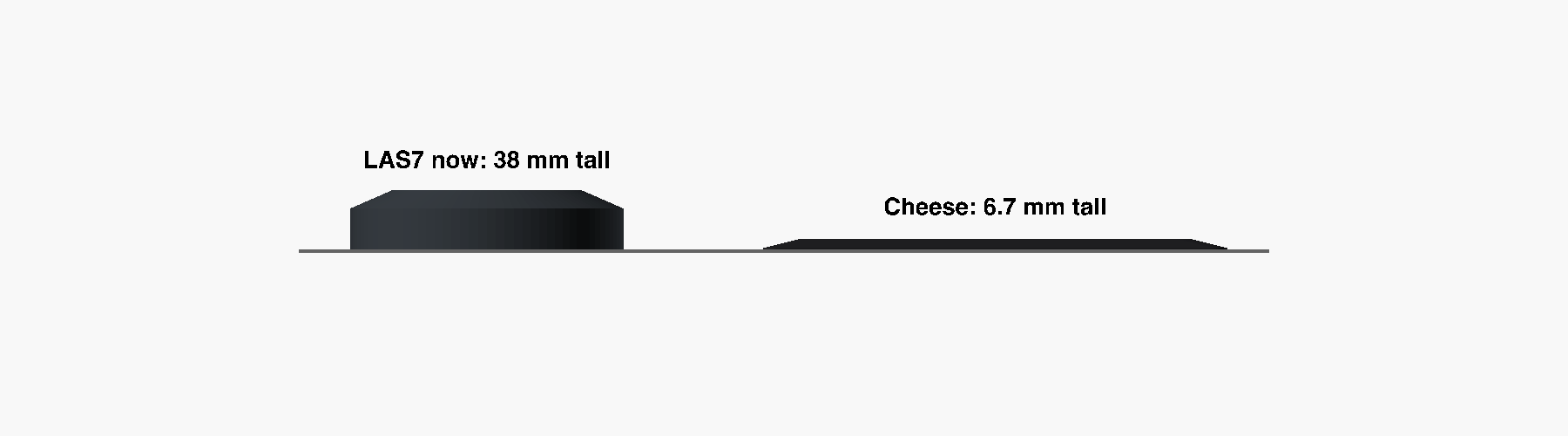
Our pilot so far has used the KKM LAS7, an off-the-shelf parking sensor. Cheese is our own design.
| KKM LAS7 (today) | Cheese (planned) | |
|---|---|---|
| Height | 38 mm | 6.7 mm |
| Footprint | 175 mm round | 297 × 210 mm |
| Sensing | Radar + one magnetometer | Two magnetometers |
| Mounting | Screws into drilled holes, per the manual | Adhesive, no drilling |
| Battery | 8,500 mAh, 8 years claimed | 4,000 mAh, ~5 years estimated |
| Arrival detected | About 1 minute, per the manual | About 10–15 s, target |
Cost
| Per sensor | |
|---|---|
| Small batch (5–6) | About $45–55, plus about $60–70 one-time setup for the circuit boards |
| 1,000 units | About $40, landed and ready to install |
| 10,000 units | About $30, landed and ready to install |
These are estimates, not quotes. The biggest one-time costs at volume would be injection molds (about $15–40k) and an FCC test for the finished product (about $3–5k). The radio module itself is already certified. Gateways are separate, about $200 each, and each one covers many spaces.
Build plan
1. Test kit Parts ordered Nov 7
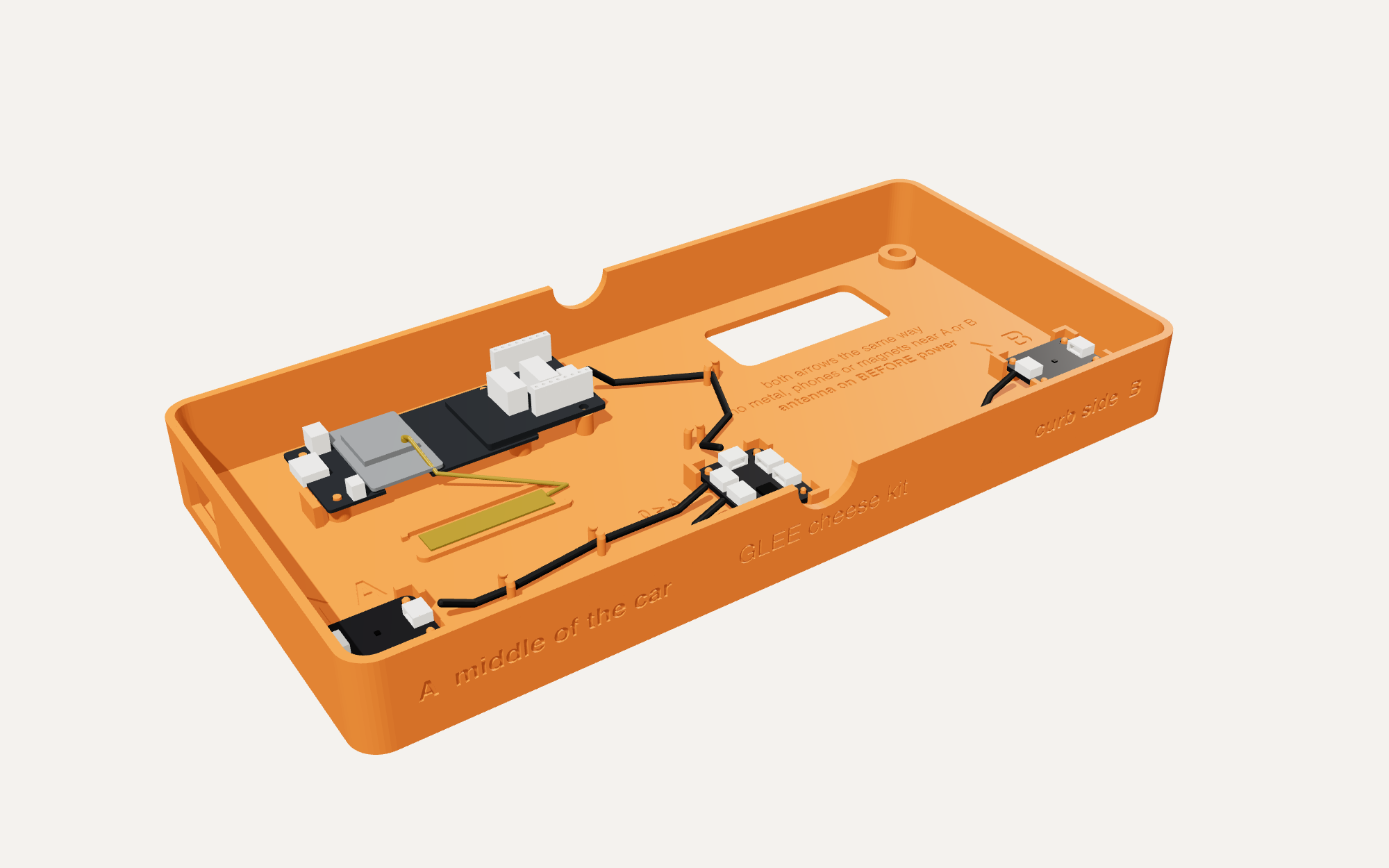
Off-the-shelf boards that click together without soldering, in a 3D-printed tray. It runs the same radio chip and software as the final design, so it answers the two big questions cheaply: can two magnetometers without radar detect cars reliably, and does the radio get out from under a car?
2. The real sensor Designed, waiting on the kit
The custom board and the 6.7 mm sheet described on this page. The board design is finished and the order files are ready. We'll only order it if the test kit shows:
- At least 95% of arrivals and departures caught over at least 20 real parking events, with no false "occupied" from a car in the next space.
- Messages still getting through with a car parked on top.
- Real numbers to set the detection thresholds.
Where we'd love your feedback
- Radio from under a car. We expect a parked car to block 10–20 dB of signal. Is the antenna in the right place, or should it sit at the curb-side edge?
- Magnetometers without radar. Will two sensors 210 mm apart reliably tell a car on top from one in the next space, including trucks, buses and cars parked off-center?
- Durability. Will a 6.7 mm printed sheet survive tires, plows and street sweepers? What material or structure would you use?
- Adhesive in the cold. We found no published strength numbers for butyl pads on asphalt at around 5 °C. Have you seen what holds up?
- Heat. The cells are rated to +60 °C, and asphalt in summer can get hotter than that. How would you handle it?
- Thinner batteries. The cells set the height. Flatter cells (1–2 mm) hold less energy. Do you know of good options or suppliers?
- Installing it for real. What would a city or a parking lot operator need to see before letting us install these?
Anything else you notice is welcome too.
Send us feedback
Cheese is designed by Albert Sveen, with Max Lightfield and William Tang, students at Harvard College.
Email us your feedback